
What Is Social Anxiety?
Social anxiety isn’t just shyness.
It’s a persistent fear of being judged, embarrassed, rejected, or negatively evaluated in social or performance situations.
People with social anxiety often:
Overthink conversations afterward
Avoid speaking up in meetings
Rehearse what they’re going to say
Feel physically anxious (blushing, shaking, racing heart)
Replay small social moments for hours
At its core, social anxiety is a threat response. Your brain treats social evaluation as danger. Even when you logically know you’re safe. This threat response is reinforced when we withdraw or avoid interacting with new or unfamiliar people.
What Causes Social Anxiety?
Social anxiety usually develops from a combination of:
Temperament (some nervous systems are more sensitive)
Early social experiences (criticism, rejection, humiliation, instability)
Learned avoidance patterns
Perfectionism or fear of mistakes
Over time, avoidance strengthens the anxiety.
You skip the party → anxiety drops → brain learns: “Avoiding keeps me safe.”
The cycle reinforces itself.
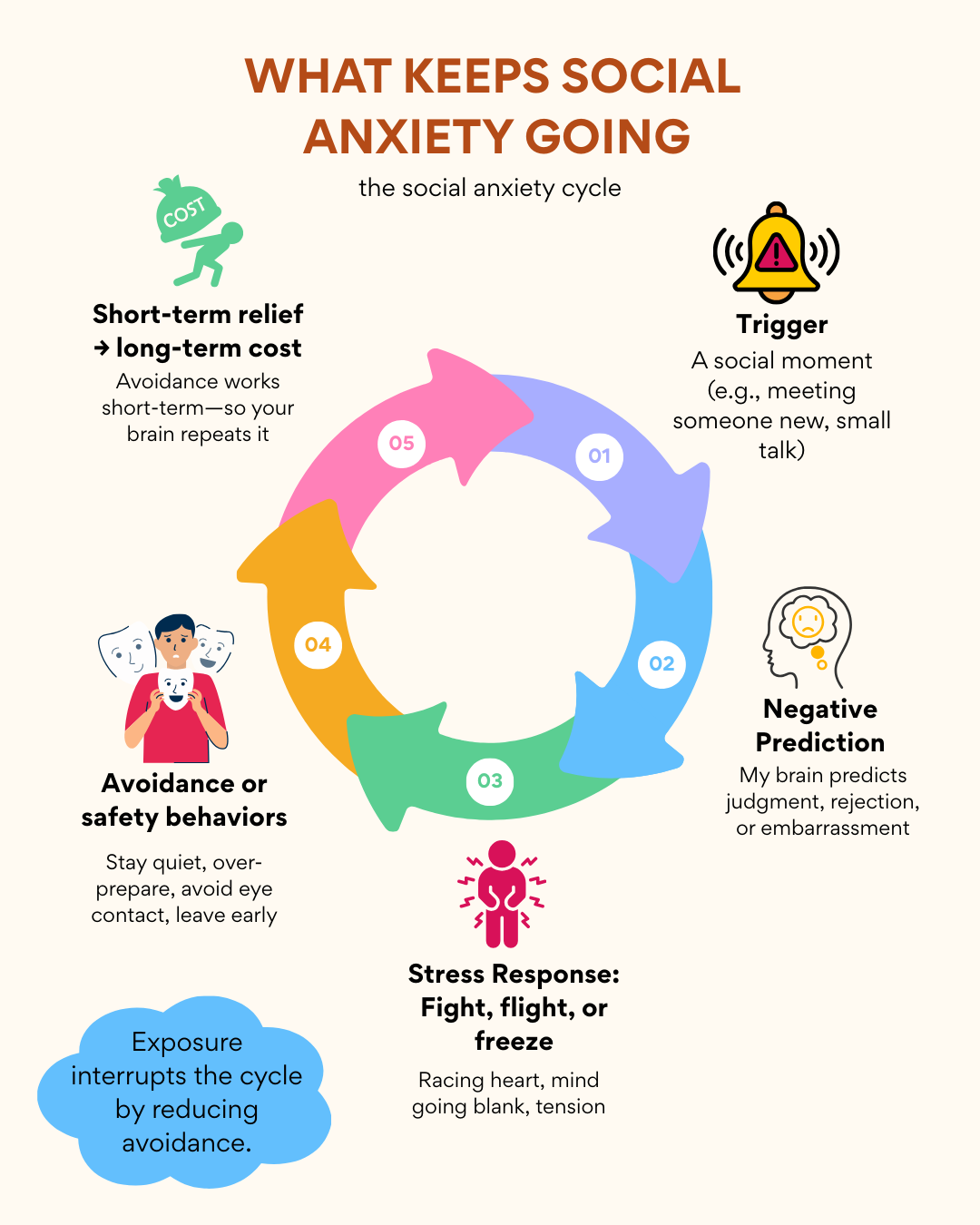
CBT model of social anxiety. Over time, avoidance strengthens the anxiety. Exposure interrupts the cycle and allows relearning that the trigger is safe.
How Is Social Anxiety Treated?
Cognitive Behavioral Therapy (CBT) has the most evidence for improving social anxiety.
CBT focuses on three main targets:
1. Thoughts
Identifying distorted thinking patterns like:
Mind reading (“They think I’m awkward.”)
Catastrophizing (“I ruined everything.”)
Spotlight effect (“Everyone noticed.”)
2. Behaviors
Reducing safety behaviors such as:
Over-preparing
Avoiding eye contact
Leaving early
Rehearsing excessively
3. Exposure
Gradually practicing feared social situations in structured ways so your brain relearns that they are tolerable and survivable.
Can Group Therapy Help Social Anxiety?
For mild to moderate social anxiety, group therapy can be even more effective than individual therapy alone.
Why? Because social anxiety is relational.
Practicing in real time with others:
Reduces avoidance
Provides corrective feedback
Increases willingness
Builds confidence through repetition
Join our group if you’re in Dallas
If you’re in Dallas and looking for structured, skills-based treatment for social anxiety, you can learn more about our 3-week Social Anxiety Intensive for young adults here: https://www.tellapsychology.com/group-therapy